Harmonizing the IT landscape
It takes quite a bit of day-to-day manual effort to operate factories’ heterogeneous IT landscapes, many of which have evolved over time. Making the most of agile methods and our experts’ talent for tailoring solutions to fit, we apply our harmonization strategy to optimize a variety of use cases in collaboration with you.
The challenge
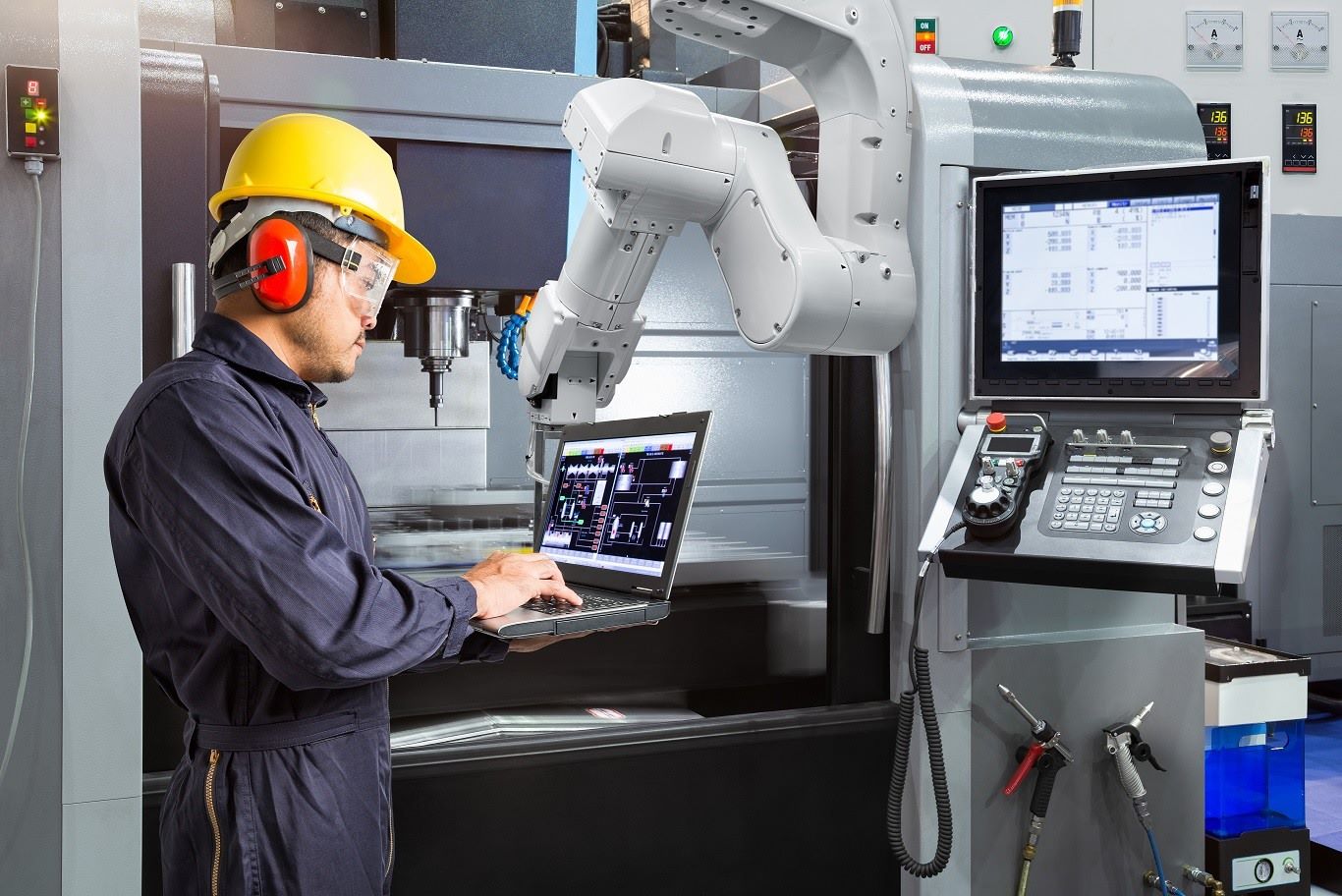
Many manufacturing and assembly operations are still underpinned by a heterogeneous IT landscape replete with fragmented systems and system and media discontinuities. Although auxiliary tools and Excel can help bridge the gaps caused by system and media discontinuities, such stopgaps greatly increase the manual workload in day-to-day manufacturing operations. This complicates efforts to extend and maintain the system landscape and schedule and manage production runs. It makes reporting more difficult. Operational efficiency suffers.
The goal of our harmonization process is to build state-of-the-art architecture for manufacturing systems that will underpin further Industry 4.0 use cases and significantly increase productivity, transparency, and traceability. Structured and proven, our method includes a localization phase, inception phases 1 & 2, and agile implementation.
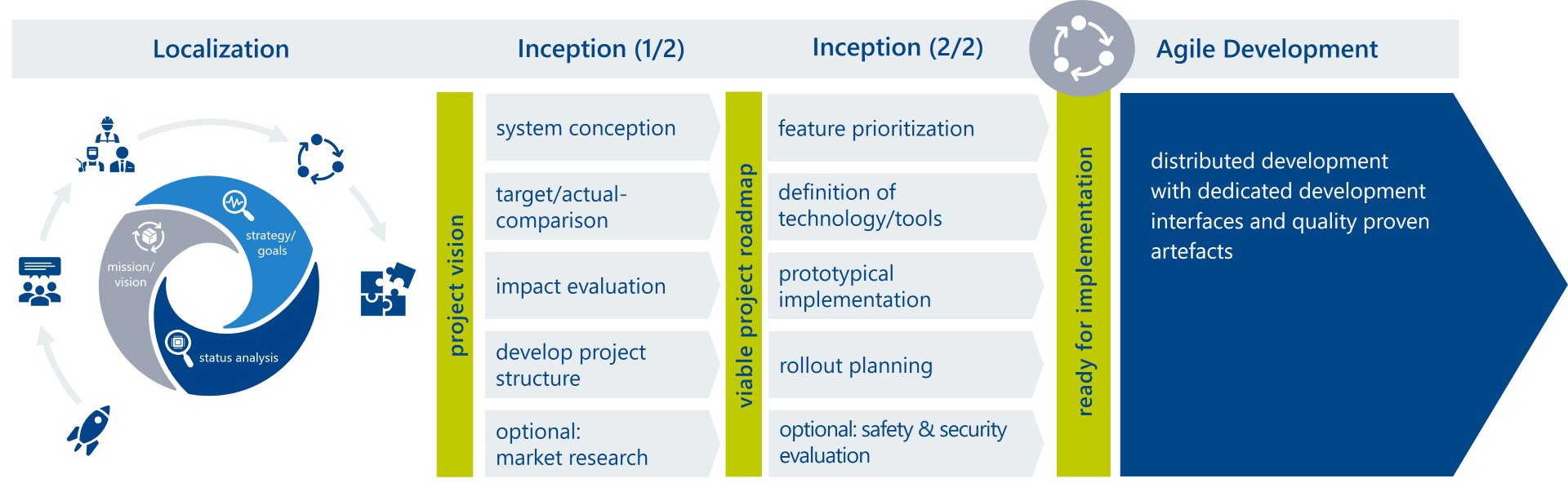
Key outcomes of the localization phase at a glance
1. Clarify the objective:
- We know what the goal is and the motivation behind it.
- We have defined the system boundary and identified the stakeholders.
- We have pinpointed and documented relevant domain specifics.
2. Determine the current status:
- We have analyzed the actionable areas for the objective – that is, the shop floor, warehouse, order processing, and the like – and understand the constraints.
- We have created a system overview incorporating all key systems and interfaces
- We know who is responsible for the various systems.
- We create further documents such as BPMN diagrams, value stream maps, information flow diagrams, and data models as required to achieve the objective.
3. Requirements for the target system:
- We have identified relevant use cases.
- We have determined explicit and implicit requirements for achieving the desired status.
- We know all about functional and non-functional requirements.
Primary results of inception phase 1 and 2
In phase 1, we outline an initial architecture for the target status and analyze the steps to close the delta between actual and target statuses. Based on this rough-draft architecture, we analyze effort versus impact and chart the implementation roadmap. We can also assess commercially available software solutions for suitability.
In phase 2, we assess technology risks using methods ranging from proof-of-concepts to minimal viable products. This yields insights that flow into the architecture. Furthermore, we create an initial prioritized backlog to transition to the agile implementation phase. We also develop a rollout strategy to smoothly integrate new components into the legacy environment. If a security concept is required, we create it during this phase.
Solving problems & creating value
Our structured approach to harmonizing the IT systems landscape
- reduces the number of systems and media discontinuities
- simplifies the system landscape, making it easier to maintain and therefore more economical
- increases transparency streamlines production scheduling and management as well as reporting

Agile development
We take an agile approach to our IT harmonization projects. In fact, all our services benefit from this state-of-the-art method of software development.
ITK expertise in podcast format
Our harmonization expert Dr.-Ing. Manuel Peter talks about the challenges of heterogeneous IT landscapes in manufacturing, provides real-world insights, and explains our harmonization approach in a Factory of the Future podcast.



Contact
Bastian Boeker
Manufacturing Industry
Unsolved challenges?
Get in touch with us. Your personal contact is:

Bastian Boeker
Manufacturing Industry
* Mandatory fields