Digital Interlockings (DSTW) – Efficient, secure, future-proof
We assist operators and the manufacturers of systems and components with the development and approval of digital interlockings (DSTW) – from requirements analysis and software development to acceptance testing in accordance with European norms and standards. We were responsible for the specifications phase of the following NeuPro subsystems: point, light signal and Generic IO, as well as maintenance and data management (MDM) – including cyber security requirements – for a leading system manufacturer. On this basis, we successfully developed and tested the MDM subsystem until formal acceptance.
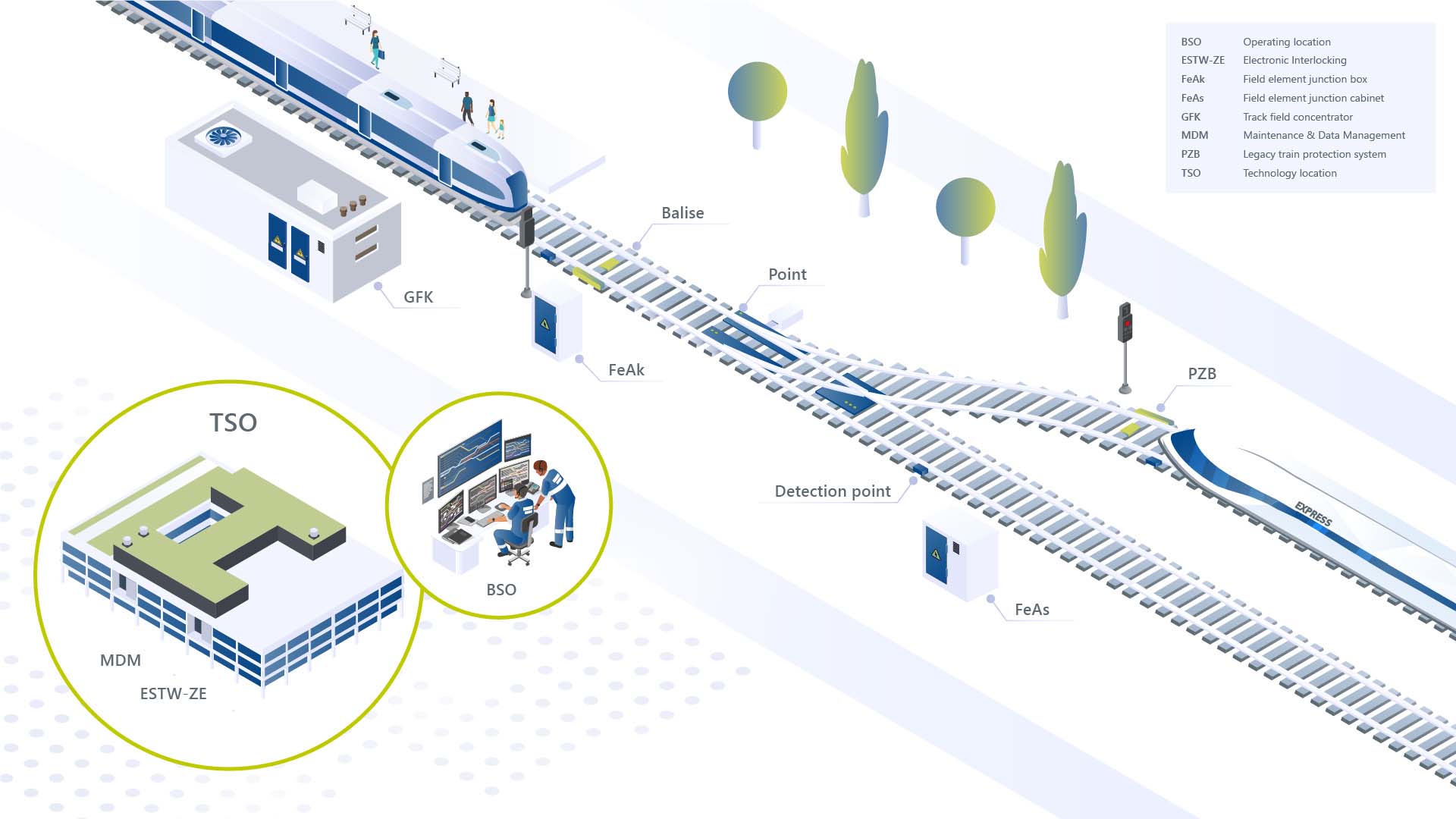
Schematic illustration of a digital interlocking system and its field elements
The challenge: Complex specifications and the scalability of digital interlockings
Developing software for digital interlockings is technically complex, and subject to challenging framework conditions. The supplier of the system or rather the digital interlocking is responsible for parts of the specifications, such as (the design and definition of) the handling of project planning and configuration data, while NeuPro does not specify any consistent standard. This gives rise to leeway for interpretation, which requires careful technical decision-making.
At the same time, the availability of various interface partners and contact points is limited during certain project phases. As a result, development is largely carried out on the basis of the specifications as well as test environments that have been developed in-house in order to verify and validate interface communications. It is also necessary to scale tests to a large number of connected systems in order to ensure interoperability, software quality and compliance with relevant standards such as EN 50716, and to demonstrate the scalability of the developed system.
The solution: Structured processes for digital interlockings
In order to implement the project, we bundled our expertise in the fields of software development and project and process management with in-depth knowledge of NeuPro specifications and technologies such as OPC UA. Based on the operator’s requirements, we derived product specification and used them to develop consolidated subsystem requirement specifications that include cyber security requirements.
The subsystem requirements for the MDM were then transformed into formal software requirement specifications. The system was designed and implemented using modern methods such as agile team organisation methods, GIT versioning and CI/CD pipelines for faster, reliable releases. Creating a test environment at an early stage made it possible to validate the interfaces and ensure compliance with the specifications and standards.
The targeted use of agile methods as part of the V-model ensured transparency, efficiency and quality-assured implementation. Thanks to our close partnership with both our client and the operator, we were able to implement short decision-making pathways and flexible development processes.
The seamless implementation of digital interlockings requires a structured approach and in-depth specialist expertise. In our working group within the business unit rail, we bring all of this know-how together and constantly discuss current developments to ensure a consistent high-quality implementation.
Our approach provides clear, standards-compliant requirements that can be implemented directly, and reduces the risk of development errors. Structured processes, agile methods within the (individual) phases of the V model and state-of-the-art development techniques make it possible to significantly shorten development cycles while keeping the quality and security of the software at the highest level by integrating cyber security at an early stage. At the same time, we make sure that digital interlocking solutions are interoperable and compliant with standards to ensure that projects can be implemented efficiently, promptly and in accordance with regulations, for long-term success at the European level.